A caregiver medical binder is one place for the medication list, appointments, providers, symptoms, questions and paperwork that arrive all at once when a parent comes home from the hospital. Build it in the first week, starting with the medication list, and give a copy to everyone who shares the care. This is organizing guidance, not medical advice; questions about doses, symptoms or what to do next go to the prescriber or pharmacist.
Why a caregiver medical binder matters in the first week
Discharge is when the information is most complete and least organized. The hospital hands over a drug list, follow-up dates and a phone number, often on several sheets, and within days the list has changed, a new specialist has been added and two people in the family are working from different versions. Medicare's discharge planning checklist asks patients and caregivers to record every prescription, over-the-counter drug, vitamin and supplement, including changes made during the stay, review it with staff to confirm which medicines and doses to continue, and share the updated list with providers (Medicare). A caregiver medical binder is where that updated list lives, so the version in the kitchen is the version in the doctor's office.
Day one: the medication list and its fields
Three federal sources describe the same list from slightly different angles. The National Institute on Aging says to write down all medicines including OTC drugs, vitamins and supplements, with "the name of each medicine or supplement, the amount you take, and time(s) you take it," and for prescriptions "the doctor who prescribed it and the reason it was prescribed" (National Institute on Aging). AHRQ says to add new medicines "when you start taking something new or when a dose changes," to keep a list of allergies and past problems with medicines, and to try to use one pharmacy so all records are in one place (AHRQ). Medicare's discharge drug list includes a column for what each medicine does (Medicare).
| Field | Why it is on the list | Basis |
|---|---|---|
| Medicine name (brand and generic) | Avoids doubling up on the same active ingredient under two names | NIA |
| Dose and form | "The amount you take" | NIA |
| Time(s) and how (with food, empty stomach) | Supports a daily schedule grid and pill-box filling | NIA |
| What it is for | Medicare's drug list has a "what it does" column; AHRQ suggests asking the doctor to write the reason on the prescription | Medicare; AHRQ |
| Prescriber | Who to call when it needs changing or refilling | NIA |
| Pharmacy and refill date | One pharmacy keeps records in one place and flags interactions | AHRQ; NIA |
| Date started, date changed, date stopped | Captures changes made in hospital and afterward | Medicare; AHRQ |
| OTC, vitamins, supplements, herbals | Every source says to list them, not just prescriptions | AHRQ; NIA |
| Allergies and past reactions | Belongs at the top of the page, not on a separate sheet | AHRQ |
Keep a second, shorter list of discontinued medicines with the date and the reason, so a well-meaning relative does not restart something that was stopped on purpose. And keep a wallet-sized copy; NIA suggests one copy in a safe place at home and one in the wallet or purse (National Institute on Aging).
The appointment log
Medicare's checklist includes a "My appointments" table for dates and times and says to bring the discharge instructions, health status summary and drug list to follow-up visits (Medicare). The log in the binder needs a little more than date and time: the provider, the purpose, who is driving, what to bring, and a space afterward for what was said and what changed. The after-visit space is the part families skip and then regret, because the one sentence the doctor said about a dose is the sentence nobody can remember a week later.
The provider directory
AHRQ's medicine guide begins with a form to list your doctors and pharmacists (AHRQ), and Medicare's checklist says to write down the names and phone numbers of the people to call with questions or concerns after discharge, and the number a caregiver should call (Medicare). The directory page should carry every active provider with role, practice, phone, portal login location (not the password) and the name of the nurse or scheduler who actually answers. Add the pharmacy, the hospital's main number and the home health agency if one is involved. One page, so it can be photocopied for the fridge.
The symptom log
NIA tells patients with side effects to "write them down so you can report them to your doctor or pharmacist accurately" and to call the doctor right away about any problems with medicines (National Institute on Aging). A symptom log is the caregiver's version of that advice: date, time, what was observed, anything measured (temperature, weight, blood pressure if the care team asked for it), what was done, who was told and what they said. It is a record, not a diagnosis. The discharge paperwork usually names the warning signs that should prompt a call; copy those onto the first page of the log so nobody has to search for them at 2 a.m.
The questions-for-the-doctor page
AHRQ's advice is plain: "write your questions down ahead of time," take the list to the appointment, and write down what the care team tells you so you remember later (AHRQ). NIA publishes a list of questions to ask about any new medicine, including what it is for, when it should start working, what side effects to expect, whether it interacts with anything else being taken, whether it is safe to stop abruptly and whether a refill needs a follow-up visit (National Institute on Aging). A running questions page in the binder lets anyone in the family add a question during the week and lets the person attending the appointment ask all of them. Leave room for the answer next to each question.
Insurance, Medicare and advance-directive paperwork
This is the section that gets requested at the worst moments. Medicare's checklist prompts caregivers to ask whether equipment such as a walker will be needed, whether Medicare covers it and who arranges delivery (Medicare), which is easier to follow up when the Medicare and supplemental insurance card copies, plan phone numbers and member IDs are on one page. Keep a claims and authorization log beside it: date, what was requested, reference number, outcome.
For advance directives, the National Institute on Aging describes the two main documents, a living will and a durable power of attorney for health care that names a health care proxy, and says to make copies, store them in a safe place and give copies to the proxy, health care providers and lawyer. It also says to review them at least once each year and after major changes in health, and when a form is updated, to keep the older version and note the date it was replaced (National Institute on Aging). The binder should hold copies and a locator line saying where the signed originals are. Whether a document is valid in your state is a question for an attorney.
Who has a copy
AHRQ says to make a copy of the medication list, keep one and give the other to a family member or friend (AHRQ). Extend that to the whole binder with a who-has-a-copy page: each person or office, which sections they hold, the date their copy was last updated. Typical holders are the parent, the primary caregiver, a sibling who covers weekends, the pharmacy (medication list only) and the health care proxy (directives and medication list). When something changes, that page is the distribution list.
A week-one build order
| Day | Build | Source behind it |
|---|---|---|
| Day 1 | Medication list from the discharge papers, reviewed against the bottles; allergies at the top; wallet copy | Medicare; NIA |
| Day 2 | Provider directory and who-to-call page; confirm one pharmacy | Medicare; AHRQ |
| Day 3 | Appointment log with every follow-up already scheduled; start the questions page | Medicare; AHRQ |
| Day 4 | Symptom log with the discharge warning signs copied onto page one | NIA |
| Day 5 | Insurance and Medicare cards, plan numbers, equipment and authorization log | Medicare |
| Day 6 | Advance directive copies and a locator for the originals | NIA |
| Day 7 | Who-has-a-copy page; distribute copies; set the first review date | AHRQ |
A binder that is already laid out
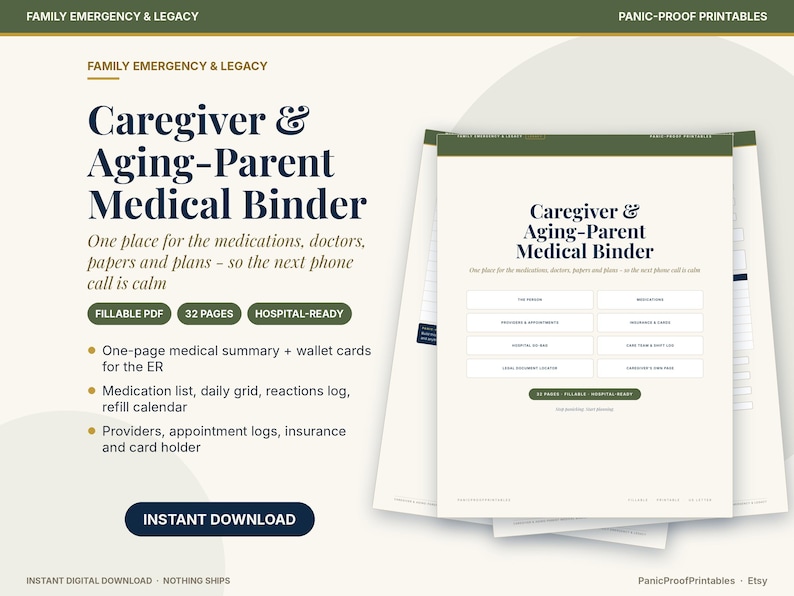
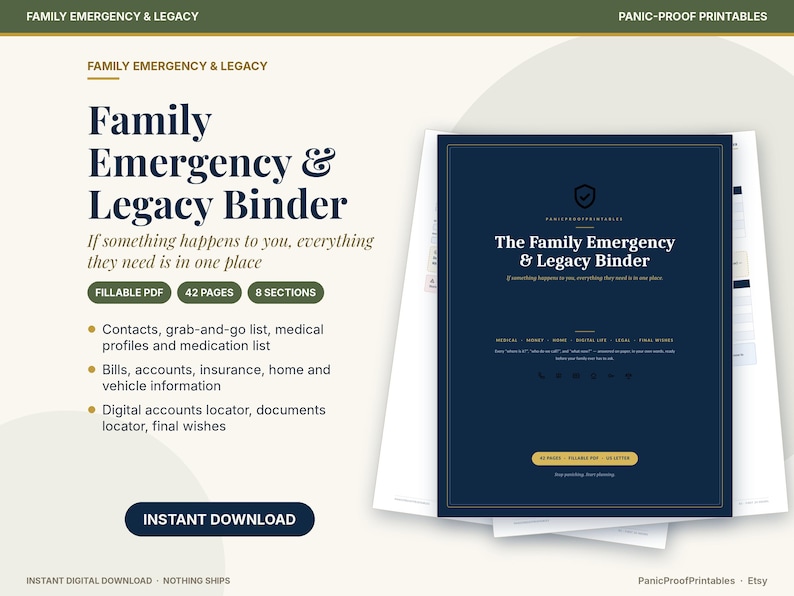
Our Caregiver Aging Parent Medical Binder is a 32-page fillable PDF built around these pages: a one-page medical summary with wallet cards, a two-page medication list with a daily schedule grid and a discontinued-medicines log, a providers directory, four appointment-log pages with question prompts, an insurance and Medicare page, a hospital go-bag checklist, a four-page symptom and incident journal, a legal document locator and a review schedule. If the same parent's finances, insurance and household details also need a home, the Family Emergency and Legacy Binder covers those sections and sits next to it on the shelf. Both are in our Emergency and Legacy collection. Neither is medical or legal advice; they are places to write down what the care team tells you.
Frequently asked questions
- What should a caregiver medical binder include?
- A medication list, appointment log, provider directory, symptom log, a running questions-for-the-doctor page, insurance and Medicare details, copies of advance directives with a locator for the originals, and a page recording who holds a copy.
- What fields belong on a medication list?
- Name, dose, when and how it is taken, what it is for, prescriber, pharmacy, start and change dates, and allergies, with OTC drugs, vitamins and supplements included. That is the combined guidance of NIA, AHRQ and Medicare's discharge checklist.
- Who should have a copy of the binder?
- The parent, the primary caregiver, anyone who covers shifts, the pharmacy (medication list) and the health care proxy (directives and medication list). AHRQ suggests giving a copy of the medication list to a family member or friend.
- How often should it be reviewed?
- Update the medication list the day anything changes, and review the whole binder after every hospital stay and at least once a year. NIA recommends reviewing advance directives at least once each year.
Sources
- AHRQ, Your Medicine: Be Smart. Be Safe.
- National Institute on Aging, Taking Medicines Safely as You Age
- Medicare, Your Discharge Planning Checklist (CMS Product No. 11376, PDF)
- National Institute on Aging, Advance Care Planning: Advance Directives for Health Care
This article is organizing guidance, not legal, medical, tax or financial advice. For advice about your situation, talk to a licensed professional.