A family emergency binder checklist has nine sections: identification, medical, financial, insurance, contacts, home, pets, digital accounts and legal documents. FEMA's Emergency Financial First Aid Kit covers the first several under four headings, and we fill in the rest below. Keep the binder somewhere a trusted person can reach it, keep the most sensitive numbers out of it, and review it once a year.
Start with the government's list, then add what it leaves out
Ready.gov's financial preparedness page tells households to "gather financial and critical personal, household and medical information" and points to the Emergency Financial First Aid Kit (EFFAK), a joint FEMA and Operation HOPE publication (Ready.gov). The EFFAK organizes records into four types: household identification, financial and legal documentation, medical information and household contacts. It also makes a point most binder templates miss: when you complete the first two sections, you have the information needed to apply for FEMA disaster assistance (FEMA EFFAK checklists).
What the EFFAK does not do is tell the person who finds the binder where the water shutoff is, how the dog is fed, or how to get into the email account that every password reset flows through. Those are the home, pets and digital sections below. The result is a family emergency binder checklist that works for a hurricane and for an ordinary Tuesday when the one person who knows everything is unreachable.
The family emergency binder checklist, section by section
1. Identification
The EFFAK's household identification checklist includes driver's licenses and other photo ID (copy front and back), birth certificates, adoption and custody papers, marriage license and divorce decree, Social Security cards, passports or Green Cards, naturalization documents, and for veterans the DD 214 discharge record (FEMA EFFAK checklists). For children, it suggests recent photographs and identification records. Add a one-page household roster: full legal names, dates of birth, employers and school contacts for every person living in the home.
2. Medical
Ready.gov lists physician information, health insurance details, immunization records and medications as the medical essentials (Ready.gov). For each person, write the current medication list with dose and prescriber, allergies, conditions, the pharmacy, and the names and numbers of the care team. If anyone has an advance directive or health care proxy, note where the signed original is; the legal section covers the documents themselves.
3. Financial
The EFFAK's financial section covers housing payments (lease, mortgage, home equity line), other obligations (utilities, vehicle loans, credit cards, student loans, child support, automatic payments), financial accounts (bank, retirement, investment), sources of income (recent pay stubs, government benefits) and tax statements (FEMA EFFAK checklists). It recommends downloading electronic statements to a removable drive every few months or printing copies roughly every three months, because the goal is proof that an account exists, its number and the institution's contact information, not a running balance.
A binder works best here as a locator rather than a vault: institution, account type, whose name is on it, how it is accessed and who to call. The reasons to keep full account numbers somewhere more secure are in the storage section below.
4. Insurance
List every policy: homeowners or renters (including riders), auto, life, flood, pet, funeral and health. The EFFAK says to call the claims number on each policy to verify the policy number is correct, keep that claims number with your records, and store copies of photos of your property and contents, including separately covered valuables (FEMA EFFAK checklists). Ready.gov adds a reminder worth writing in the margin: homeowners insurance typically does not cover flooding (Ready.gov).
5. Contacts
Ready.gov's household contacts list is banking institutions, insurance agents, health professionals, service providers and place of worship (Ready.gov). The EFFAK's forms add employers and supervisors for each adult, school contacts for each child, and two emergency notification contacts who should be told if something happens to you (FEMA EFFAK checklists). Include one out-of-area contact, since local phone lines are the ones that fail in a regional emergency.
6. Home
This section is for whoever is standing in your kitchen while you are not: the location of the water main, gas shutoff and breaker panel, the alarm code and where the spare key lives, the mortgage servicer or landlord, utility account numbers and the contractors you trust. Add vehicle details (plate, VIN, where the title is) and a valuables inventory with photos.
7. Pets
Ready.gov tells pet owners to keep copies of registration information and other relevant documents in a waterproof container and available electronically, to have the pet microchipped with current contact details plus an out-of-area emergency contact, to keep an extra supply of regular medications, and to include a picture of you and your pet together to document ownership if you are separated (Ready.gov, pets). The EFFAK adds ID tag numbers and microchip account information (FEMA EFFAK checklists). Write the feeding routine, the vet's number and who has agreed to take the animal.
8. Digital accounts
No federal checklist covers this well, so treat it as a locator page: the primary email account that receives password resets, the phone carrier and plan, the password manager and where its recovery key is kept, two-factor backup codes, cloud storage and photo backups, subscriptions, and any domains or online businesses. Do not write live passwords in the binder. Write where they are and how a trusted person gets access.
9. Legal documents
Wills, trusts, powers of attorney, advance directives, deeds, titles and the name and number of the attorney who drafted them. The National Institute on Aging says to make copies of advance directives, store them in a safe place, and give copies to your health care proxy, health care providers and lawyer (National Institute on Aging). The binder should say where the signed originals are. Laws vary by state; a licensed attorney is the right source for which documents you need and how they must be executed.
| Section | What goes in | Basis |
|---|---|---|
| Identification | Photo ID copies, birth and marriage certificates, Social Security cards, passports, DD 214, household roster | FEMA EFFAK |
| Medical | Physicians, insurance, immunizations, medications, allergies, care team | Ready.gov |
| Financial | Housing, debts, accounts, income, taxes, statements every few months | FEMA EFFAK |
| Insurance | Every policy, verified claims numbers, property photos | FEMA EFFAK |
| Contacts | Banks, agents, providers, employers, schools, two emergency contacts | Ready.gov; FEMA EFFAK |
| Home | Shutoffs, panel, codes, utilities, contractors, vehicles, valuables | Our addition |
| Pets | Registration, microchip, medications, photo with owner, routine, vet | Ready.gov, pets |
| Digital accounts | Primary email, carrier, password manager location, backups, subscriptions | Our addition |
| Legal documents | Will, trust, powers of attorney, advance directives, attorney, where originals are | National Institute on Aging |
Where to keep it, and a warning about sensitive numbers
Ready.gov's advice is to store important documents "either in a safety deposit box, an external drive or on the cloud" so they are accessible during a disaster (Ready.gov). In practice most families end up with two layers: a physical binder at home that a spouse, adult child or neighbor can open quickly, and a backup copy (encrypted drive or password-protected cloud folder, or a second paper copy at a relative's house) in case the home is the emergency.
The warning is about what goes in the home binder. The Federal Trade Commission says to keep your financial records, Social Security and Medicare cards, and any other documents with personal or financial information "in a safe place," and to shred them when you dispose of them (Federal Trade Commission). A binder on a shelf is a convenience, which is the opposite of a safe. Our approach: the binder holds locators (which bank, which policy, where the card is), while full Social Security numbers, account numbers and card images live in a locked box or safe deposit box the binder points to. The EFFAK itself suggests copying items you normally carry, such as insurance cards, rather than storing the originals (FEMA EFFAK checklists). If you choose to keep the full numbers in the binder anyway, keep the binder in a locked, fire-resistant box and tell only the people who need to know.
How to keep it current
A binder that was accurate three years ago is a different kind of problem: it is trusted and wrong. The EFFAK builds the fix into its forms with a "Date Added/Updated" column on every checklist, intended as "a useful reference point to remind you when it is time to review or update the document" (FEMA EFFAK checklists). The National Institute on Aging says advance directives should be treated as living documents and reviewed at least once each year, and updated after major life events such as retirement, moving to another state or a significant change in health (National Institute on Aging). Ready.gov tells pet owners to review their kits regularly so food and medicines stay fresh (Ready.gov, pets).
A workable routine is one annual review on a fixed date, plus a page in the binder where you log the review and anything that changed. Between reviews, the events that should trigger an update are predictable:
- A move, a new job, a new child or a death in the household.
- A new bank account, loan, policy or a change of insurer.
- A new medication, diagnosis, doctor or pharmacy.
- A new phone number, email account or password manager.
- A pet adopted, rehomed or microchipped.
- Any legal document signed or revoked.
Putting it together
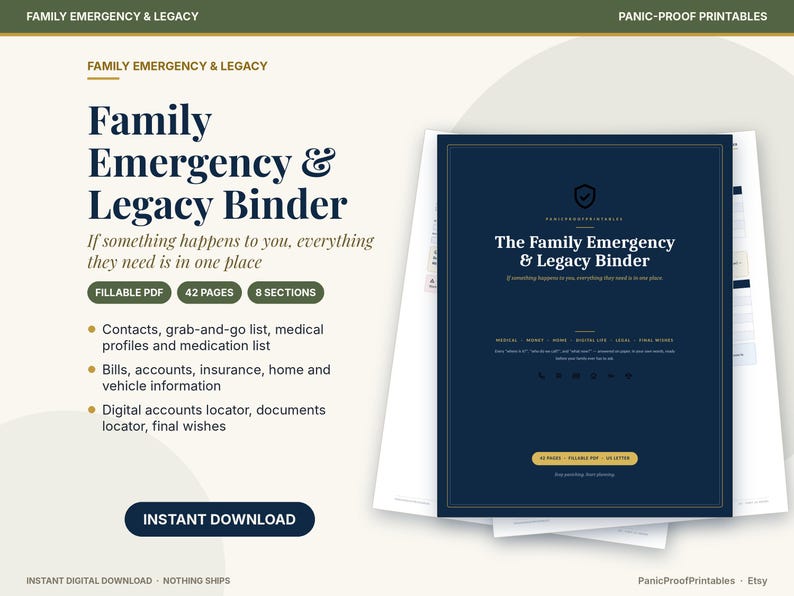
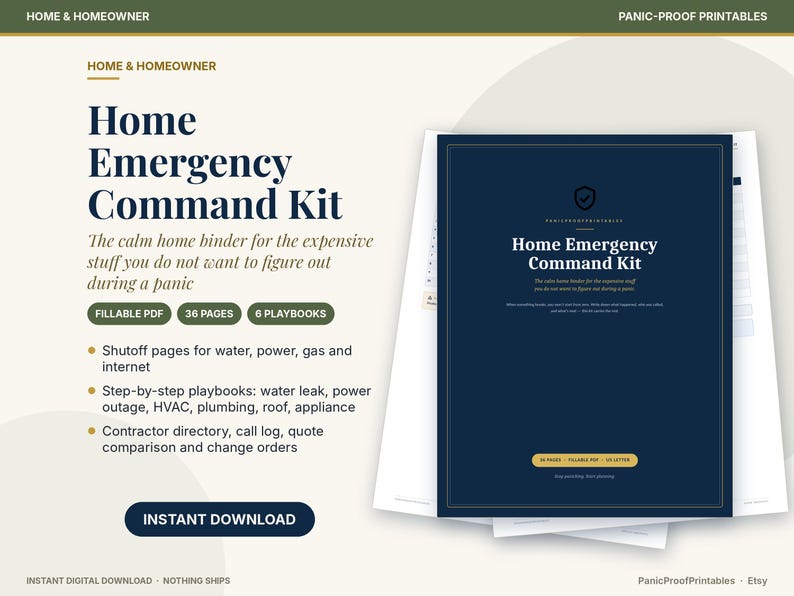
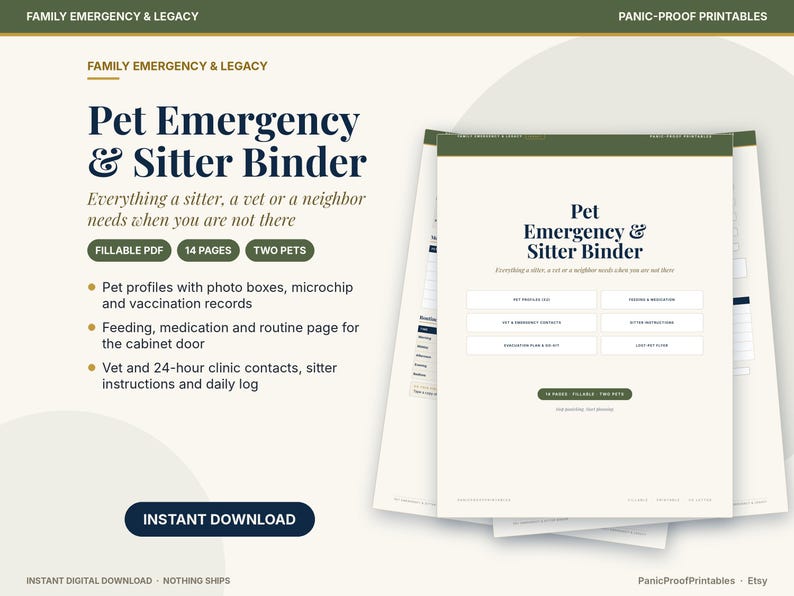
If you would rather fill boxes than design pages, our Family Emergency and Legacy Binder is a 42-page fillable PDF built around this checklist: a first-24-hours contact sheet and finder's page, household and medical profiles, an accounts locator (not an account vault), insurance snapshot, home information, digital accounts locator, documents locator and a review schedule. The Home Emergency Command Kit goes deeper on the home section with shutoff pages, contractor logs and six step-by-step playbooks for leaks, outages and storm damage. The Pet Sitter Binder covers the pet section in the detail a sitter actually needs, including an evacuation plan and a lost-pet flyer. All three are in our Emergency and Legacy collection. None of them is legal, financial or insurance advice; for which documents your family needs and how they must be signed, ask a licensed professional in your state.
Frequently asked questions
- What should be in a family emergency binder?
- Identification, medical, financial, insurance, contacts, home, pets, digital accounts and legal documents. FEMA's EFFAK covers identification, financial and legal, medical and contacts; the home, pet and digital sections fill the gaps.
- Should I put Social Security numbers in the binder?
- Only if the binder itself is locked up. The FTC says to keep Social Security and Medicare cards and financial records in a safe place. A safer pattern is a binder of locators that points to a locked box holding the full numbers.
- Where should the binder be kept?
- Ready.gov suggests a safety deposit box, an external drive or the cloud. Most families keep a reachable copy at home plus a backup elsewhere, so the binder survives if the house is the emergency.
- How often should it be updated?
- Review it once a year on a fixed date and after major life events. The National Institute on Aging recommends reviewing advance directives at least once each year, and FEMA's EFFAK forms carry a date-updated column for the same reason.
Sources
- Ready.gov, Financial Preparedness
- FEMA, Emergency Financial First Aid Kit: Checklists and Forms (FEMA P-2063, PDF)
- Ready.gov, Prepare Your Pets for Disasters
- Federal Trade Commission, What To Know About Identity Theft
- National Institute on Aging, Advance Care Planning: Advance Directives for Health Care
This article is organizing guidance, not legal, medical, tax or financial advice. For advice about your situation, talk to a licensed professional.