In the first 72 hours after a layoff, the order matters more than the speed. Read every page of the separation paperwork before you sign anything, settle how you will stay insured, file for unemployment in the state where you worked, and then work out your runway in months. That is what to do financially after a layoff, and everything else, including the job search itself, can wait until day four.
This checklist is organized by the hour so you can stop and start. It describes organizing steps, not legal, tax or financial advice, and it flags the points where a licensed professional earns their fee.
Hours 0 to 12: read the separation paperwork slowly
You will probably receive a packet or a portal link with a separation agreement, a benefits summary and a final pay statement. Do not sign the agreement on the day you receive it. Most agreements give a review window, and signing early buys you nothing.
Three numbers matter most. Severance is not required by federal law; the U.S. Department of Labor states that it is a matter of agreement between the employer and the employee, so the amount, the payment schedule (lump sum or salary continuation) and any conditions are whatever the document says. Your final paycheck is governed by state law; the DOL last paycheck guidance notes that federal law does not require immediate payment but some states do. Payout of unused vacation is also a matter of agreement or state rule, since the DOL vacation leave guidance confirms the FLSA does not require payment for time not worked.
If the layoff was part of a large cut, check whether notice was given. Under the federal WARN Act, employers with 100 or more employees generally owe 60 calendar days of written notice before a plant closing or a mass layoff affecting 50 or more workers at a single site, per the DOL WARN Act summary. States may have their own versions with lower thresholds.
Write a one-page summary before you close the packet: severance amount and pay date, final paycheck date, PTO hours and the rate they are paid at, the date health coverage ends, your retirement plan balance and vesting, the equipment return deadline, and the name of one HR contact. If the agreement asks you to release legal claims, or you suspect the layoff was not what it appears, this is the moment to pay an employment attorney for a review, before you sign.
Hours 12 to 24: decide how you will stay insured
Health coverage has deadlines that run from the date your employer plan ends, not from the day you feel ready to deal with it. You generally have three routes, and the clocks are different lengths.
| Option | Deadline to act | What to know |
|---|---|---|
| COBRA (stay on the employer plan) | 60 days from the later of the date coverage ends or the date the election notice is sent, per the DOL COBRA FAQ | Applies to plans of employers with 20 or more employees; you may be charged up to 102 percent of the plan's cost (DOL COBRA overview); up to 18 months after a termination |
| Marketplace plan | 60 days before or after losing coverage (HealthCare.gov) | Coverage can start the first day of the month after your job-based plan ends; premium savings depend on household income |
| Spouse's or partner's employer plan | Request enrollment within 30 days of losing coverage (DOL Work Changes Require Health Choices) | Special enrollment means you do not wait for their open enrollment |
Two practical notes. The COBRA election notice can take up to 44 days to arrive after the qualifying event, so do not wait for it to compare prices; get a Marketplace quote now. And if a spouse's plan is the choice, the 30-day window is the shortest of the three, so that call comes first.
Hours 24 to 48: file for unemployment where you worked
Unemployment insurance is a joint state-federal program, and each state sets its own eligibility rules and benefit amounts. The DOL unemployment insurance page says to contact your state program as soon as possible after becoming unemployed, and that it generally takes two to three weeks after filing to receive a first payment. Filing on day two instead of day twelve moves that first payment forward by the same ten days.
Use the CareerOneStop Unemployment Benefits Finder to pick the state where you worked, which is not always the state where you live. Before you start the application, gather your Social Security number, the employer's legal name and address, your start and end dates, the stated reason for separation, and the severance terms from your one-page summary. States ask about severance because it can affect when benefits begin, and the state's own site is the only reliable answer on that.
Put the weekly certification day on your calendar now. Missing a certification is the most common way people lose a week of benefits they were entitled to.
What to do financially after a layoff comes down to one runway number
Runway is how many months you can cover essential expenses with the money you have and the money you know is coming. The formula is simple enough to do on paper:
Runway in months = (cash on hand + money owed to you) ÷ (monthly essential expenses minus monthly income you can count on)
Here is a worked example with illustrative figures, not a recommendation. Someone has $9,000 in savings, a final paycheck and PTO payout of $4,500 arriving next week, and $6,000 in severance, for $19,500 in total. Their essential monthly spend, after cutting the optional items, is $3,900.
| Scenario | Money available | Monthly gap | Runway |
|---|---|---|---|
| No unemployment benefits yet | $19,500 | $3,900 | 5.0 months |
| With an estimated $1,600 a month in benefits | $19,500 | $2,300 | 8.5 months |
| Benefits plus $800 a month of part-time or contract income | $19,500 | $1,500 | 13.0 months |
The point of the table is the difference between the rows, not the numbers themselves. A modest, reliable income bridge stretches runway more than any single cut in spending. The Layoff Financial Triage Kit includes a runway calculator in Google Sheets and Excel that recalculates as the inputs change, which matters because they will change weekly.
Pause and rank the bills
With a runway number in hand, go through every recurring payment and sort it into three groups: keep, pause, and call. Keep covers housing, utilities, groceries, insurance premiums, prescriptions and the minimum payments on any debt secured by something you need, like a car. Pause covers subscriptions, memberships and automatic transfers to savings or extra debt payments. Call covers anything you may not be able to pay in full next month.
Call before a payment is missed, not after. Ask each lender or servicer whether it offers a hardship program, a payment deferral or a changed due date, and write down the representative's name, the date and what was offered. The CFPB Your Money, Your Goals toolkit includes a bill calendar and a prioritizing-bills worksheet built for exactly this sorting exercise. Do not cancel insurance to save money; a gap in coverage is the one cut that can cost more than it saves.
If debt payments are already the largest line, a nonprofit credit counselor can review the whole picture at little or no cost, and that conversation is better had with five months of runway than with one.
Retirement accounts: leave it, roll it, do not cash it casually
Your 401(k) or similar plan does not need a decision this week, which is the reason to decide nothing this week. The IRS termination of employment topic lists four options when employment ends: leave the money in the old plan, roll it to a new employer's plan, roll it to an IRA, or withdraw the balance. It also notes that if the balance is under $5,000, the employer may require you to move it, so read the plan's notice for that threshold.
Cashing out is the expensive option. The IRS rollover rules explain that a distribution paid to you is subject to mandatory 20 percent federal withholding, and you then have 60 days to roll the full amount into another plan or IRA. If you are under 59 1/2, IRS Topic 558 adds a 10 percent additional tax on the amount not rolled over, unless an exception applies; one exception covers distributions after separating from service after reaching age 55. A direct rollover, where the plan pays the new account directly, avoids the withholding entirely.
If the balance is significant, or you are weighing a withdrawal to extend runway, a tax professional or a fee-only financial planner should see the numbers first. The tax on a casual cash-out can be larger than the month of expenses it buys.
Day 4 onward: the 30-day, 60-day and 90-day plan
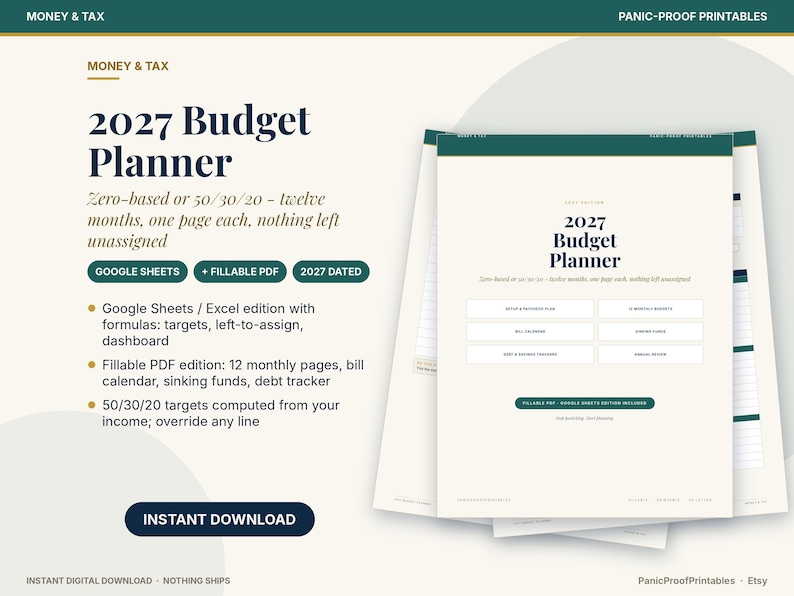
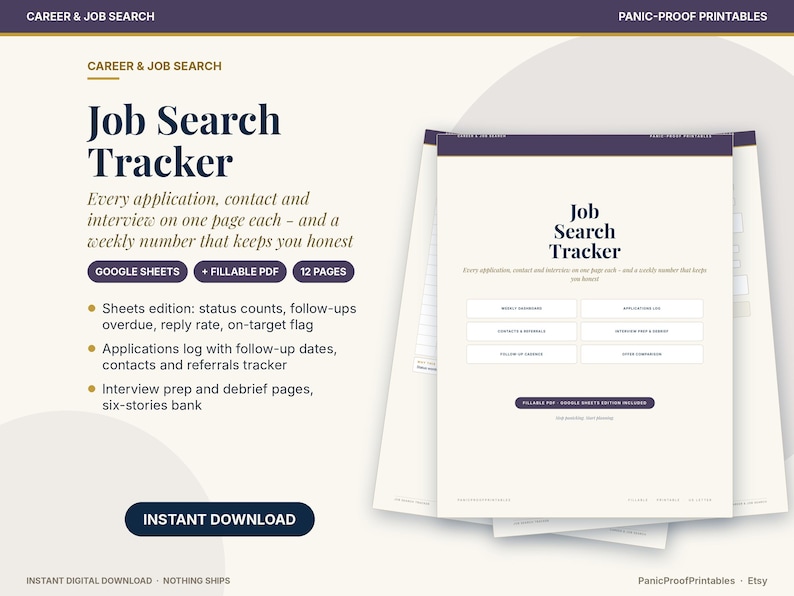
From here the work shifts from triage to rhythm. In the first 30 days, certify for benefits every week, confirm your health election before its deadline, update the runway sheet each Friday, and set up a job search tracker so follow-ups do not depend on memory. By day 60, revisit the bills you paused, decide whether the income bridge is working, and move the monthly budget into a format you will keep using after the next offer; the 2027 Budget Planner works in Google Sheets or as a fillable PDF for that reason.
By day 90, if runway has fallen below three months, that is the trigger to widen the search, take bridge work, or talk to a credit counselor, not a reason to wait and see. Keep the one-page summary from hour zero at the front of the folder; every form you fill out in the next three months asks for something on it.
The rest of our money and budget planners cover what comes after the triage: a 52-week savings restart, a debt payoff plan and a zero-based budget for the year ahead.
Frequently asked questions
- Should I take COBRA or a Marketplace plan after a layoff?
- Compare both before the COBRA election notice arrives. COBRA keeps your current doctors and deductible progress but can cost up to 102 percent of the plan's full price; a Marketplace plan may qualify for income-based savings. Both windows are 60 days, so get a Marketplace quote in the first week and decide on paper.
- Does severance pay delay unemployment benefits?
- It depends on the state where you worked. Some states reduce or delay benefits while severance is paid; others do not count it. File anyway as soon as possible, answer the severance questions accurately, and let the state's determination letter tell you the timing.
- How do I calculate how long my savings will last after a layoff?
- Add cash on hand to money you know is coming (final pay, PTO payout, severance), then divide by your monthly essential expenses minus any income you can count on, such as unemployment benefits. The result is your runway in months. Recalculate it weekly as the inputs change.
- Should I cash out my 401(k) after a layoff?
- Not casually. A distribution paid to you faces 20 percent mandatory withholding, and if you are under 59 1/2 a 10 percent additional tax on anything not rolled over within 60 days, unless an exception applies. Leaving the money in the plan or doing a direct rollover avoids both. Talk to a tax professional before taking any withdrawal.
Sources
- U.S. Department of Labor, Severance Pay
- U.S. Department of Labor, Last Paycheck
- U.S. Department of Labor, Vacation Leave
- U.S. Department of Labor, Plant Closings and Layoffs (WARN)
- U.S. Department of Labor, FAQs on COBRA Continuation Health Coverage for Workers
- U.S. Department of Labor, Continuation of Health Coverage (COBRA)
- U.S. Department of Labor, Work Changes Require Health Choices
- HealthCare.gov, If You Lose Job-Based Coverage
- U.S. Department of Labor, Unemployment Insurance
- CareerOneStop, Unemployment Benefits Finder
- Consumer Financial Protection Bureau, Your Money, Your Goals toolkit
- IRS, Retirement Topics: Termination of Employment
- IRS, Rollovers of Retirement Plan and IRA Distributions
- IRS, Topic No. 558, Additional Tax on Early Distributions
This article is organizing guidance, not legal, medical, tax or financial advice. For advice about your situation, talk to a licensed professional.