Zero-based budget vs 50/30/20 comes down to one question: do you want to decide where every dollar goes, or do you want three big buckets and a quick check that the proportions are sane? Zero-based is the more precise and more effortful plan; 50/30/20 is the faster diagnostic. Many people end up using 50/30/20 to check the shape of their budget and zero-based to run the month. Below, both methods on one illustrative income, a comparison table, what to do with variable income and sinking funds, and how to set either one up in a spreadsheet and a fillable monthly page. This is an organizing guide, not financial advice.
What the 50/30/20 rule is
The 50/30/20 rule splits after-tax income into three buckets: no more than 50 percent to needs, no more than 30 percent to wants, and at least 20 percent to savings and debt payments (Experian). Needs are the bills you must pay to keep life running: housing, utilities, groceries, transportation, insurance and minimum debt payments. Wants are everything you choose: restaurants, streaming, hobbies, travel. The 20 percent covers emergency savings, retirement contributions and payments on debt above the minimum.
The rule was popularized by Elizabeth Warren and her daughter Amelia Warren Tyagi in their book All Your Worth: The Ultimate Lifetime Money Plan (Experian). The Consumer Financial Protection Bureau describes it as a common rule of thumb, applied to take-home pay, and notes that consumers sometimes find rules like it hard to apply to their own circumstances, which is why its worksheet invites you to set your own percentage for wants instead (CFPB). That caveat is worth keeping in mind. The numbers are a starting shape, not a standard.
What a zero-based budget is
A zero-based budget assigns every dollar of income a specific job before the month starts, so that income minus planned spending and saving equals zero. Utah State University Extension puts it plainly: your income and your expenses should be equal and every dollar should have a specific purpose, including treating savings goals as expenses and giving yourself a personal allowance (Utah State University Extension). Zero does not mean you spend everything. It means nothing is left unassigned, and the money headed for savings is a line item like rent.
The cost is effort. A zero-based budget needs a list of every category, a number for each, and a check that the lines add to your income. It also needs maintenance during the month, because when groceries run over, that money has to come from a named line somewhere else. The reward is that there is no vague "miscellaneous" where a few hundred dollars disappear.
Zero-based budget vs 50/30/20 on one illustrative income
The figures below are illustrative. They are round numbers chosen to make the arithmetic visible, not a recommendation for any household. Assume monthly take-home pay of $4,000.
Under 50/30/20 the targets are $2,000 for needs, $1,200 for wants and $800 for savings and debt. That takes thirty seconds. It tells you the shape you are aiming at, but nothing about whether this month's rent, car insurance and the dentist fit inside $2,000.
The zero-based version of the same $4,000 lists every line:
| Line | Amount | 50/30/20 bucket |
|---|---|---|
| Rent | $1,400 | Needs |
| Utilities, internet, phone | $250 | Needs |
| Groceries | $450 | Needs |
| Transportation | $300 | Needs |
| Insurance | $150 | Needs |
| Minimum debt payments | $200 | Needs |
| Eating out | $150 | Wants |
| Subscriptions | $50 | Wants |
| Hobbies and fun | $150 | Wants |
| Clothing and personal | $100 | Wants |
| Emergency fund | $300 | Savings and debt |
| Retirement | $200 | Savings and debt |
| Extra debt payment | $150 | Savings and debt |
| Sinking funds (car repair, gifts, annual fees) | $150 | Savings and debt |
| Total | $4,000 | Remaining: $0 |
Now run the 50/30/20 check against those lines. Needs total $2,750, which is 69 percent of income. Wants total $450, or 11 percent. Savings and debt, including the sinking funds, total $800, exactly 20 percent. The zero-based plan balances, and the savings target is met, but the proportions say something useful: housing and fixed costs are eating the room that 50/30/20 would allot to wants. That is not a failure. It is the diagnostic doing its job. In a high-rent city this shape is common, and the response is a decision, not shame: accept the trade for now, look at the housing or transportation lines over the next year, or adjust the percentages to a rule you can actually live with, which is what the CFPB worksheet suggests.
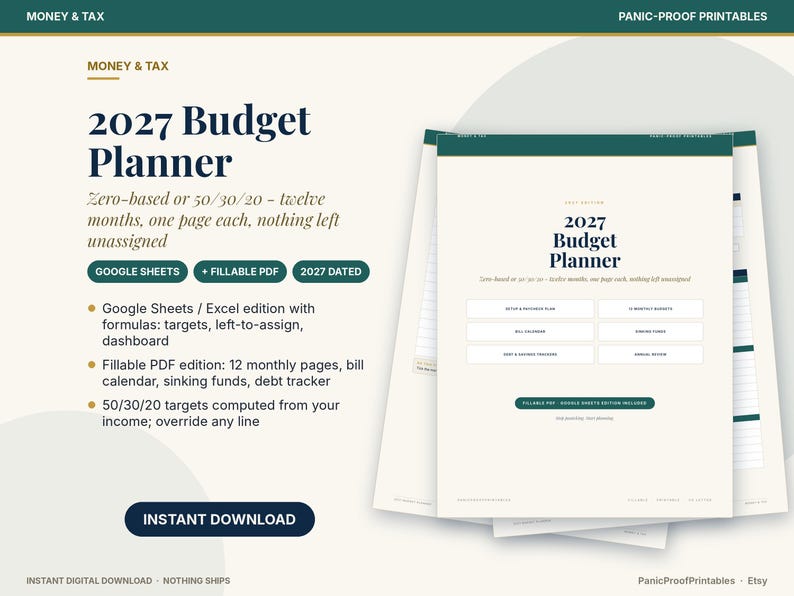
This is why the two methods are not really rivals. 50/30/20 is a thirty-second check on shape. Zero-based is the operating plan that gets you through the month. Our 2027 budget planner runs in either mode for exactly that reason, with a per-line override so you can set a 50/30/20 target and still see every dollar.
Comparison table
| 50/30/20 | Zero-based | |
|---|---|---|
| Setup effort | Low: one income figure and three percentages | High: every category listed and totaled |
| Monthly effort | Low: check three totals | Moderate: reassign money when a line runs over |
| Best for | Steady income, a first budget, a quick check on whether the shape is reasonable | Tight margins, debt payoff, variable income, anyone who wants to know where every dollar went |
| Main weakness | Percentages may not fit high housing costs; the buckets hide detail | Takes time to maintain; easy to abandon after one messy month |
| What it tells you | Whether the proportions are sane | Whether this specific month balances |
| How to switch to the other | Expand each bucket into its lines and make them sum to income | Add up your lines by bucket and compare to 50, 30 and 20 |
What to do with variable income
Commission, tips, freelance and seasonal work make both methods harder, because the income figure at the top of the page is a guess. The extension services agree on the fix. Base the budget on your lowest month in the last six months or year, so you are planning for the worst case, or on your average, and when a month comes in above that number move the extra into a separate account you draw from in a lean month (Utah State University Extension). Penn State Extension adds that the figure should be net income, take-home pay after taxes and deductions, and that fixed expenses get listed and covered first, with flexible spending taking whatever is left (Penn State Extension).
In practice, variable income pushes you toward zero-based. With 50/30/20 the percentages still apply, but applying 30 percent to a number that swings from $3,000 to $5,500 produces a wants budget that is wrong in both directions. Zero-based on the low month, with the surplus buffer as a named line, is steadier. Penn State notes that nearly one quarter of US consumers report their income changing somewhat or a lot from month to month, citing CFPB survey data, so this is not an edge case (Penn State Extension).
Sinking funds
A sinking fund is a line in the budget for an expense you know is coming but not monthly: car repairs, holiday gifts, annual insurance premiums, a vet visit, the renewal fee on something. Penn State Extension describes setting money aside for periodic expenses such as car repairs, holidays and vacations alongside the emergency fund (Penn State Extension). The arithmetic is simple: estimate the annual cost, divide by twelve, and treat the result as a fixed line.
Sinking funds fit either method. In zero-based they are simply lines, and the money accumulates in a separate account or a tracked balance. In 50/30/20 they belong in the 20 percent bucket while they are being built up, which is also where the CFPB worksheet places emergency savings. The planner's sinking fund tab keeps a running balance for each fund so that a $600 car repair in March draws from a fund that has been receiving $75 a month, not from groceries.
Setting up either method in a spreadsheet
Both methods need the same skeleton. One tab per month, or one block per month on a single sheet, with four parts.
- Income at the top. One cell for take-home pay. For variable income, this is your low-month or average figure, not this month's hope.
- Category lines. One row per line with a planned amount and an actual amount. Tag each row Needs, Wants or Savings in a third column.
- Totals. A SUM of planned amounts, a SUM of actuals, and a Remaining cell that equals income minus planned. In zero-based mode you adjust lines until Remaining reads zero. In 50/30/20 mode you add three SUMIF formulas that total each tag and divide by income to show the percentage.
- Carry-over. A row that pulls last month's unspent amounts in sinking fund and savings lines forward, so balances build.
That is the whole structure. Twelve tabs plus a dashboard that reads the totals from each is enough for a year. Our 2027 planner's workbook follows this layout with 16 tabs: start here, dashboard, setup, twelve months and a sinking funds tab, with the formulas already in place so you type your own numbers into the input cells and the totals calculate.
The fillable monthly page
A spreadsheet is where the plan is built. A one-page fillable PDF is where it gets looked at. The monthly page has the same four parts in a layout that fits one screen: income at the top, the lines in the middle with planned and actual fields, the three bucket percentages for a 50/30/20 check, and a Remaining box at the bottom that you want to read zero. Fill it in on a phone in Adobe Acrobat Reader or another PDF app that saves form fields, or print it and keep it where the bills land. The budget planner's 21-page PDF pairs twelve of these monthly pages with a bill calendar, a debt tracker and an annual review.
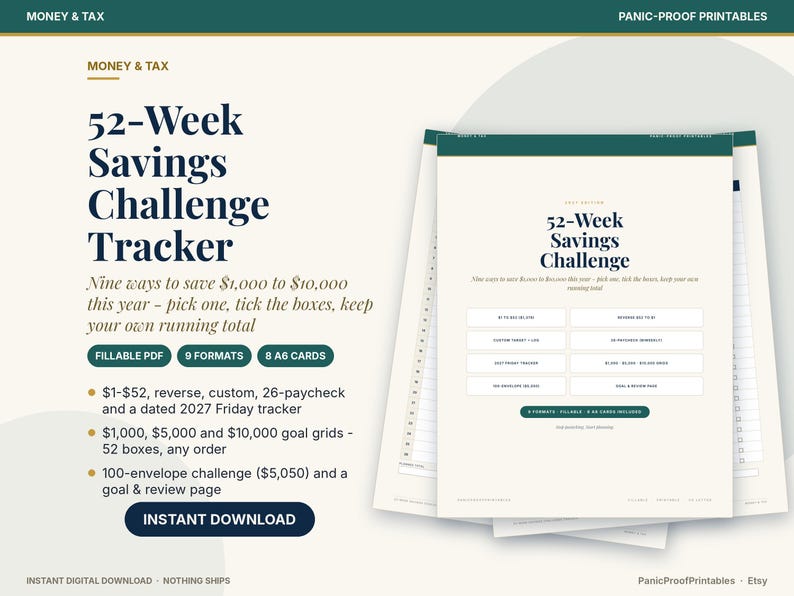
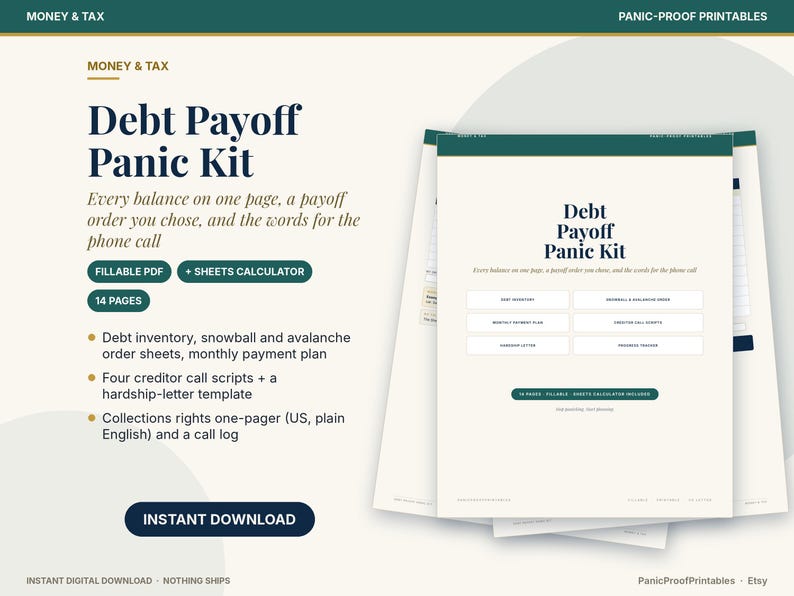
Two companions fit the 20 percent bucket. The 52-week savings challenge tracker gives the emergency fund line a visible weekly target, and the debt payoff planner ranks balances by snowball or avalanche order so the extra debt payment line has a destination. Everything in the Money and Budget collection is a planning tool. For questions about debt relief, tax treatment or investment choices, a licensed professional is the right person to ask.
Frequently asked questions
- Is zero-based budgeting better than 50/30/20?
- Neither is better in general. Zero-based is more precise and better for tight margins, debt payoff and variable income. 50/30/20 is faster and works as a quick check on whether your proportions are reasonable. Many people use both.
- Is 50/30/20 based on gross or after-tax income?
- After-tax, or take-home, pay. If retirement contributions or health premiums come out of your paycheck before you see it, count them in the bucket they belong to rather than ignoring them.
- What if my needs are more than 50 percent?
- That is common where housing is expensive. The rule is a starting shape, not a standard. Build the zero-based version so the month balances, then decide whether to adjust the percentages or work on a large fixed line over time.
- How do I budget with irregular income?
- Budget on your lowest month from the last six to twelve, or on your average, using take-home pay. Cover fixed expenses first, and move anything above the budgeted income in a good month into a buffer account for lean months.
Sources
- Experian, What Is the 50/30/20 Budget Rule?
- Consumer Financial Protection Bureau, My spending rule to live by (worksheet)
- Utah State University Extension, Family Budgeting with an Irregular Income
- Penn State Extension, Budgeting with Irregular Income
This article is organizing guidance, not legal, medical, tax or financial advice. For advice about your situation, talk to a licensed professional.