An ADHD planner that actually works is the one you can open on a bad Tuesday after three blank weeks and use without penalty. In practice that means undated pages or a dated layout that treats a skipped week as a skipped week, one page per day, a field for emptying your head, a shorter plan for low-energy days, links so you never scroll, and a file you can fill in on your phone. The rest of this post explains why each of those matters and how to restart when you stop.
Why dated planners record failure
A conventional dated planner has one job: match each page to a calendar day. For many people that is fine. For an ADHD brain it quietly turns into a ledger. Every day you did not open it leaves a dated blank, and after two weeks of blanks the planner stops being a tool and becomes a record of what you did not do.
The pattern is familiar. A strong start in January or September, a few good weeks, one chaotic stretch, then the planner is under a pile and opening it feels like opening a bill. The problem is not willpower. The format punishes the exact thing ADHD makes most likely, which is inconsistency, and it punishes it in a way that gets worse the longer you are away. Every planner in our ADHD planners collection is built around that fact, including the dated one.
Point of performance: the planner has to be where the task is
Psychologist Russell Barkley describes ADHD as a performance problem rather than a knowledge problem. People usually know what they need to do; the difficulty is acting on it at the moment it matters. He calls that moment the point of performance, and he argues that the most useful supports change the environment at that point instead of trying to build skills in the abstract (ADDitude). His list of point-of-performance supports starts with externalizing time, using calendars, whiteboards and visual timers because internal cues are unreliable, and with bringing the future closer by dividing a long goal into smaller, adjacent steps.
CHADD's Attention magazine describes the same principle: tools people can use in the actual situations where the skills are needed most, many of them visual or other external reminders and cues (CHADD). A planner is an externalizing device. It only works if it is physically or digitally in front of you when you decide what to do next, and if opening it costs almost nothing.
That is the whole design brief. Not a prettier calendar, but a surface that holds today's three tasks, the thing you are worried about, and the next small step, in the place you will actually look.
What matters in an ADHD planner that actually works
These are the features we would check before buying any planner, ours included. None of them are decorative.
Undated pages, or a dated layout that forgives
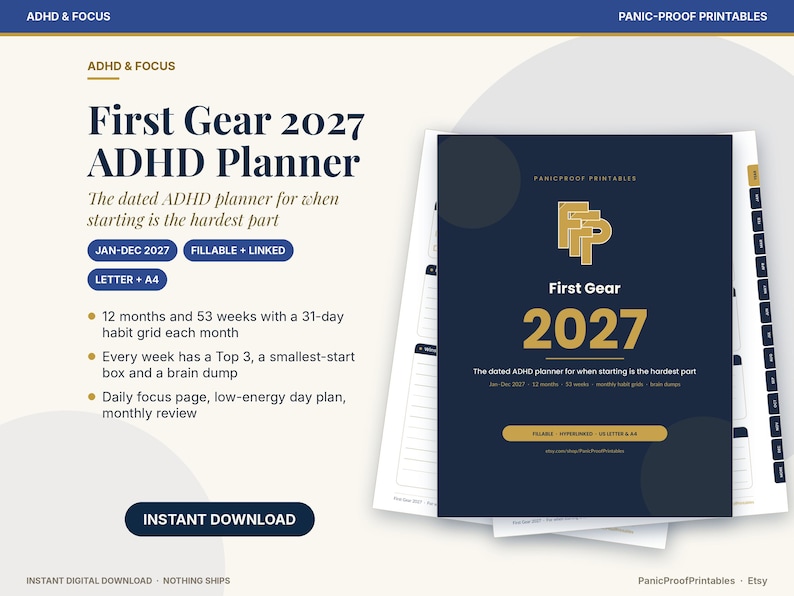
Undated daily pages mean a lapse costs nothing. You pick up where you are, write today's date, and go. If you want dates, because dates help with deadlines and with losing track of which week it is, choose a layout that does not stack blank pages against you. Our 2027 ADHD planner is dated, with 12 monthly pages and 53 weekly pages, but it is built on one rule printed on the start-here page: a blank week is not failure, open the next one. Each week stands alone, so a missed stretch is empty paper, not a debt.
One page per day
A week-on-two-pages spread gives each day a strip about the width of a sticky note. That is enough for appointments and not enough for a brain that needs to see priorities, time blocks and overflow at once. One full page per day leaves room for three priorities, a rough timeline, a short list of everything else, and a line for how the day went. It also makes the planner usable on a phone, since one page fits one screen without zooming.
A brain dump field
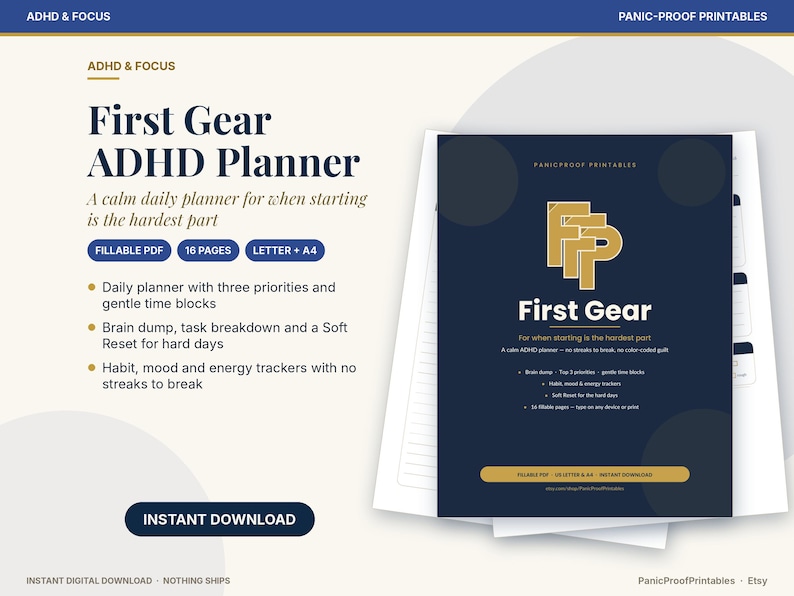
The brain dump field is where everything goes first, before any of it is sorted or judged. Its job is to get the open loops out of working memory and onto a surface where you can see them. Our ADHD daily planner leads with a brain dump page, then a top-three box, then a task-breakdown page that shrinks the scariest item into five-minute steps. The order matters: dump, then choose, then shrink. Choosing before dumping means you are choosing from whatever happens to be loudest.
A low-energy day plan
Most planners assume every day has the same capacity. ADHD days do not. A low-energy day plan is a separate, shorter page for days when the full layout is too much: a smaller number of tasks, the non-negotiables such as medication, food and one phone call, and permission to stop there. The 2027 planner includes one, and the daily planner's Soft Reset page does the same job. Having that page ready in advance matters, because deciding what bare minimum means is itself hard on a low-energy day.
Hyperlinks for navigation
In a PDF planner, hyperlinks mean tapping a month on the year page to open that month, or tapping a week to jump to that week, instead of scrolling through 80 pages to find today. Scrolling is a small cost, but small costs are what decide whether you open the file at all. Every page in our dated planner links back to the year view and forward to its month, so you are never more than two taps from where you need to be.
Fillable on your phone
The planner you will open is the one on the device in your hand. A fillable PDF opens in Adobe Acrobat Reader, Apple Preview, Xodo, Chrome or Edge; you tap a field, type, and save your copy. The same file prints in US Letter or A4 if paper is what works for you, and you can print the one page you need rather than the whole thing. Fillable means you are not locked into one format for the year.
Paper vs app vs fillable PDF
Each format has a real strength and a real failure mode. Barkley has argued for going low tech: phones, tablets and smart watches may be lost, drained of battery or out of sync and can add stress rather than relieve it, so his suggestion is pen and paper as the external storage device for working memory (ADDitude). We agree that the right format is the one you will look at, and we think a fillable PDF is a reasonable middle ground because it can be either.
| Question | Paper planner | Planner app | Fillable PDF |
|---|---|---|---|
| Where it lives | Wherever you left it | On your phone, behind a lock screen and other apps | On your phone and laptop, or printed, your choice |
| What a skipped week looks like | Blank dated pages you can see | Overdue badges and notifications that pile up | Pages you simply do not open; nothing nags |
| Moving a task | Cross out and rewrite | Drag or reschedule | Edit the field or type it on the next page |
| Navigation | Flip pages and tabs | Menus and views | Tap-to-jump links |
| Dependence on battery and sync | None | High | Low; the file works offline and prints |
| Cost over time | A new book every year | Often a subscription | One file, printed as many times as you like |
| Where it fails | Lost under a pile, no backup | Becomes one more app you avoid | Needs a PDF reader that saves form fields |
The honest summary: if you have never kept a paper planner alive past March, an app will not fix that, and neither will a PDF. What might help is a format whose cost of restarting is close to zero. That is the quality to shop for, whatever the medium.
How to restart after a lapse without backfilling
Restarting is the skill. Here is the sequence we print inside our planners, in order.
- Do not fill in the missed days. Not even a summary. Backfilling is a tax on restarting, and the information is not worth the cost of paying it.
- Open today's page, or the next weekly page if your planner is dated. Write the date.
- Spend five minutes on a brain dump of everything that piled up during the gap. Do not sort while you write.
- Pick three items for today. Only three. Everything else stays on the dump page and is still there tomorrow.
- For the hardest of the three, write the smallest first step, something under five minutes, such as finding the email or opening the file.
- If even that is too much, switch to the low-energy day plan and do the non-negotiables.
One thing that tends to slip during a lapse is household upkeep, because nothing on a daily page reminds you that the furnace filter or the smoke alarm battery was due. Our free one-page When Did I Last? sheet lists twelve recurring tasks with their sourced intervals, so after a gap you can check what actually came due rather than carrying a vague sense that everything did.
Choosing between the daily planner, the dated planner and the bundle
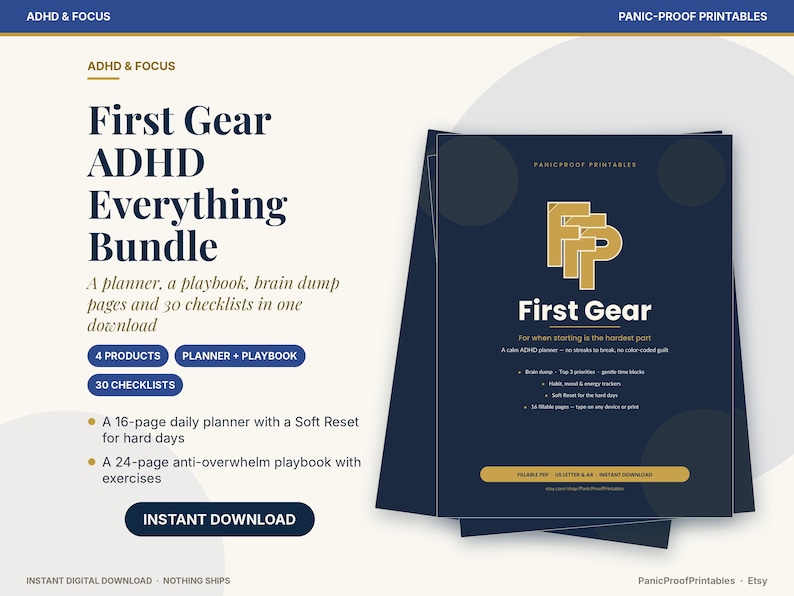
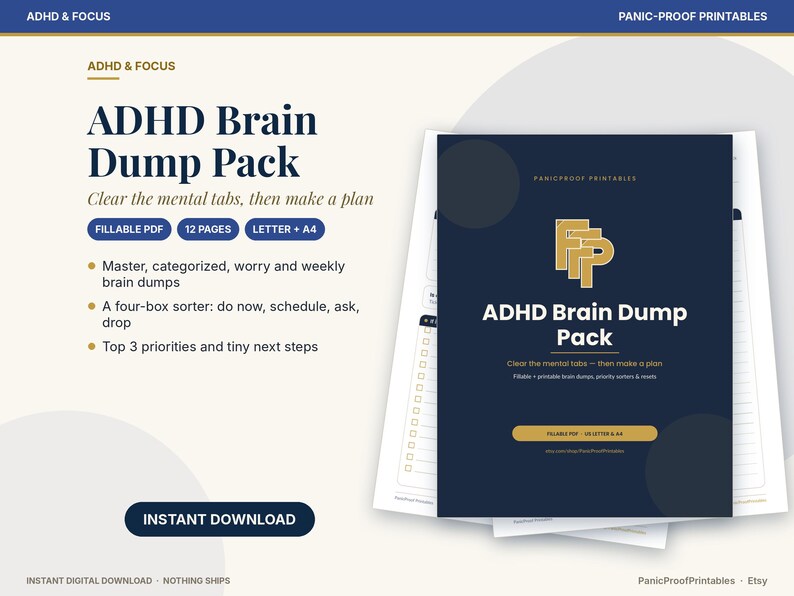
If you want to try the method cheaply, start with the 16-page daily planner. If you need dates for school, work or appointments, the 2027 planner adds the year, month and week structure on top of the same daily page. If you want everything in one download, the ADHD planner bundle combines the daily planner, the brain dump pack, an anti-overwhelm playbook and 30 checklists across 85 pages. All three are fillable PDFs in US Letter and A4.
These are organizing tools built for ADHD brains, not treatment. If attention or follow-through is affecting your health, work or relationships, a licensed clinician is the right person to talk to.
Frequently asked questions
- Is an undated planner better than a dated one for ADHD?
- Undated is more forgiving because a lapse leaves no blank dated pages. Dated helps with deadlines and time blindness. If you choose dated, pick a layout where each week stands alone so a missed stretch is not a visible debt.
- Should I fill in the days I missed?
- No. Backfilling makes restarting more expensive and the information is rarely useful. Open today's page, write the date, dump what piled up, and pick three things.
- Can I use a fillable PDF planner on my phone?
- Yes. Open it in Adobe Acrobat Reader, Xodo or another PDF app that saves form fields, tap a field, type, and save your copy. Hyperlinked pages let you jump to today without scrolling.
- What is a low-energy day plan?
- A shorter page for days when the full planner is too much: a few non-negotiables such as medication, food and one call, and permission to stop there. Having it ready in advance removes the hardest decision of a bad day.
Sources
- ADDitude, Russell Barkley, Intention Deficit Disorder: Why ADHD Minds Struggle to Meet Goals with Action
- CHADD Attention Magazine, Mark Katz, Interventions at the Point of Performance (October 2013)
- ADDitude, Your Brain's GPS Is Glitchy: Why Working Memory Fails and How to Bolster It
This article is organizing guidance, not legal, medical, tax or financial advice. For advice about your situation, talk to a licensed professional.