An ADHD brain dump is a ten-minute routine for getting everything out of your head and onto one page, then sorting it into four buckets, picking three things, writing the smallest first step for each, and parking the rest where you can find it. It is not a to-do list. It is the step before the to-do list, and for a brain that holds too many open loops at once it is usually the step that was missing.
Why working memory load is the real problem
Working memory is the part of thinking that holds information in mind while you use it: the phone call you meant to make, the form that is due, the thing your partner asked for this morning. Russell Barkley calls it the brain's GPS, the system that guides and directs action, and he describes it as commonly weak in people with ADHD. His answer is a strategy he calls externalizing, which means getting the information out of the brain and into the environment so the brain is less taxed, starting with the simplest version: write things down on paper (ADDitude).
The research base is strongest for children. A meta-analysis of 26 studies published in the Journal of the American Academy of Child and Adolescent Psychiatry found that children with ADHD showed deficits across multiple components of working memory, independent of language learning problems or general intellectual ability (PubMed). We are not clinicians and this post is not a diagnosis of anyone. The practical point is simpler: if holding six things in mind is expensive for you, stop holding them. Put them on a page.
That is the whole logic of the brain dump. The goal is not productivity. The goal is to stop paying the carrying cost of unsorted loops so that choosing one thing becomes possible.
The 10-minute ADHD brain dump, step by step
Set a timer for ten minutes. You need one page and something to write with, or the fillable version on your phone. The steps run in order and the timing is deliberate: the sorting takes less time than most people expect, and the dump takes more.
| Minutes | Step | What you are doing | What you are not doing |
|---|---|---|---|
| 0 to 4 | Dump everything | Writing every open loop, worry, errand and half-idea as it comes | Sorting, judging, deciding if it belongs |
| 4 to 7 | Sort into four buckets | Marking each line T, W, S or N | Rewriting items or planning them |
| 7 to 8 | Pick three | Choosing three items from the Today bucket | Choosing four, or the three hardest |
| 8 to 10 | Smallest first step | Writing one physical action under five minutes for each of the three | Writing the whole plan |
| After | Park the rest | Leaving the page where you will see it tomorrow | Copying everything into an app |
Step 1: Dump everything
Write without stopping. Tasks, worries, things you forgot to reply to, the vague sense that something is due, the dentist, the fact that the car makes a noise. Do not decide whether an item is real or important. If it is taking up space in your head, it goes on the page. Most people run out of items around minute three and then remember two more; wait for those.
Step 2: Sort into four buckets
Go down the list and mark each line with one letter. Do not rewrite anything yet.
- T, Today. It has to happen today or something breaks: a deadline, a pickup, a medication refill, a bill that is due.
- W, This week. It matters, but not today. Most items land here.
- S, Someday. A real idea or want with no deadline. Writing it down is how you stop re-remembering it.
- N, Not mine. Something you are carrying that belongs to someone else, or that you have already decided not to do. Crossing these out is the most relieving part of the exercise.
The Not mine bucket matters more than it looks. A surprising share of the carrying cost comes from items that are not actually yours: a colleague's deadline, a friend's decision, a project you quietly dropped months ago but never formally let go of.
Step 3: Pick three
From the Today bucket, choose three. If Today has seven items, that is information: some of them are really This week, and the ones that are genuinely all due today need help, a deadline conversation or a decision about which one slips. Three is the number because it fits on a phone screen, survives a bad afternoon, and leaves room for the day to go wrong. If you finish three, you can pull a fourth from the list. You rarely need to plan for that.
Step 4: Write the smallest first step
For each of the three, write one physical action you can finish in under five minutes. Not "do taxes" but "find last year's return in the email." Not "call the clinic" but "look up the clinic's number and put it in the planner." Barkley describes this as bringing the future to the present: dividing a goal into smaller, adjacent steps so there is always a next action close enough to take (ADDitude). The first step is the one you are most likely to skip, which is why it gets written down.
Step 5: Park the rest
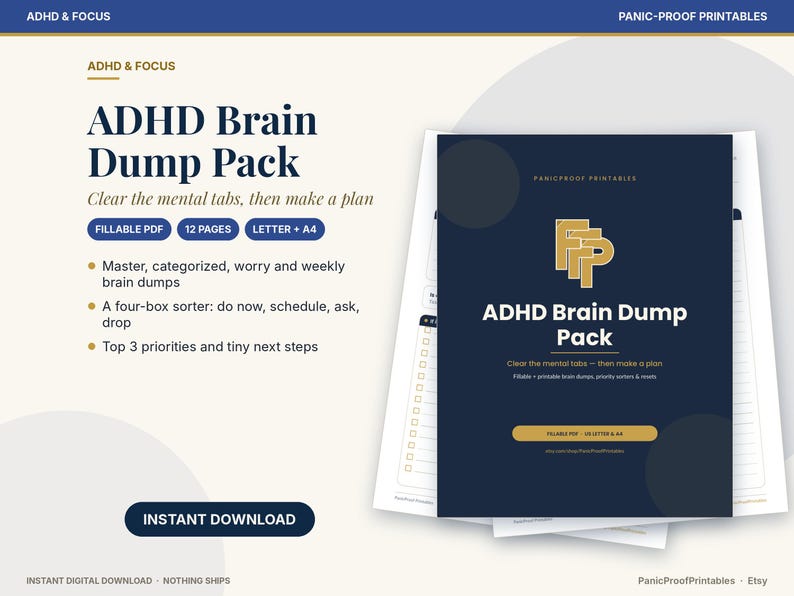
Everything marked W or S stays on the page. Do not copy it into an app, a second list or a notebook. The brain dump page is the parking lot, and its job is to be findable tomorrow. Our ADHD brain dump pack is built around exactly this flow: a master dump, a sorter page for do now, schedule, ask or drop, a top-three page and a tiny-next-steps page, all fillable so the parked items carry over without retyping.
A worked example
This is an example, not a real person. It is here to show what the sorted page looks like after ten minutes.
The dump, as written: renew car registration, reply to the landlord about the leak, finish the slide deck for Thursday, buy a birthday gift, the laundry, book a dentist appointment, call back about the insurance claim, look into that pottery class, the recycling, my sister's moving plan, cancel the streaming trial, figure out why the kitchen light flickers, draft the email to the school, read the article a friend sent, return the library books.
| Bucket | Items |
|---|---|
| Today | Reply to landlord about the leak; call back about the insurance claim; cancel the streaming trial (renews tonight); recycling (pickup is tomorrow morning) |
| This week | Slide deck for Thursday; birthday gift; laundry; dentist appointment; email to the school; library books |
| Someday | Pottery class; the article a friend sent; the flickering kitchen light |
| Not mine | Sister's moving plan; car registration (checked: not due for four months) |
Today has four items, so one has to move. The recycling takes two minutes and gets done during the dump itself, which is allowed. The three: landlord, insurance, streaming trial. The smallest first steps: open the landlord's last text and reply with two sentences and a photo; find the claim number in the inbox and write it on the page; open the streaming app's account page. None of those takes five minutes. The slide deck, which felt like the loudest item, turns out to be a This week item with a clear deadline, and it goes on tomorrow's daily page instead.
Notice what happened to the carrying load. Fifteen items became three actions and a parked list. The two items in Not mine were producing a steady background hum for no reason. That is the point.
When to repeat the ADHD brain dump
There is no streak to maintain. The dump is a tool you reach for when the head is full, and there are a few predictable times when it is full.
- When you cannot start. Frozen in front of a long list is the classic trigger. Ten minutes of dumping usually breaks it.
- Sunday evening or Monday morning. A weekly dump feeds the week's daily pages. Our ADHD daily planner opens with a brain dump page for this reason, followed by the top-three box.
- Before a low-energy day. If you can feel tomorrow is going to be hard, dump tonight so tomorrow only requires picking from a page, not generating one.
- After a lapse. If the planner has sat untouched for two weeks, the dump is how you restart without backfilling. Everything that piled up goes on one page and gets sorted once.
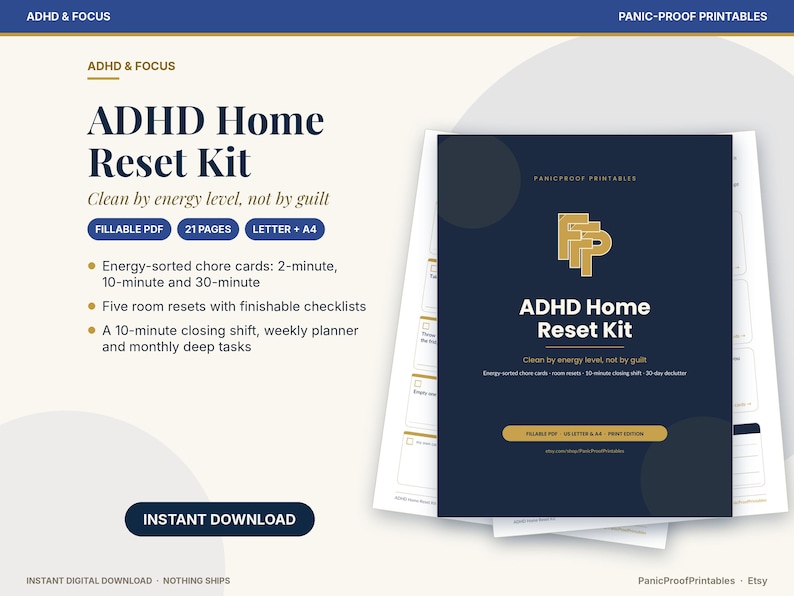
- When the house is the problem. A home-specific dump, sorted by energy rather than urgency, is how our ADHD home reset kit works: check in low, medium or high, then pick from that page only.
One category of item tends to escape every dump because it has no natural trigger: recurring household tasks. Nobody remembers the dryer vent until something smells. Our free one-page When Did I Last? sheet holds twelve of those tasks with their sourced intervals, so they live on a page instead of in the background hum.
Paper, phone or both
Barkley's own suggestion is to start low tech, with pen and paper, because phones and tablets can be lost, run out of battery or fall out of sync and add stress rather than remove it (ADDitude). We think the right surface is whichever one you will open at minute zero. A fillable PDF lets you do the dump on your phone in a waiting room and the sort on a laptop later, or print one page and keep it on the fridge. What matters is that there is one page, not three.
Everything in the ADHD planners collection is an organizing tool built for ADHD brains, not treatment. If overwhelm is affecting your health, work or relationships, a licensed clinician is the right person to talk to.
Frequently asked questions
- How long should an ADHD brain dump take?
- About ten minutes: four to dump, three to sort, one to pick three, two to write first steps. If it is taking much longer, you are planning instead of dumping. Stop sorting and go back to writing.
- What are the four buckets?
- Today, This week, Someday and Not mine. Mark each line with one letter, then pick three from Today. Not mine is for items that belong to someone else or that you have already decided to drop.
- Should I type my brain dump into an app?
- Only if the app is where you will look tomorrow. One page, paper or fillable PDF, is easier to find than a list spread across three places. The parked items should stay on the dump page, not be copied.
- How often should I do it?
- Whenever your head is full, and at a few predictable times: Sunday evening, the night before a hard day, and after any lapse in using your planner. There is no streak to keep.
Sources
- ADDitude, Your Brain's GPS Is Glitchy: Why Working Memory Fails and How to Bolster It
- Martinussen R, Hayden J, Hogg-Johnson S, Tannock R. A meta-analysis of working memory impairments in children with ADHD. J Am Acad Child Adolesc Psychiatry, 2005 (PubMed)
- ADDitude, Russell Barkley, Intention Deficit Disorder: Why ADHD Minds Struggle to Meet Goals with Action
This article is organizing guidance, not legal, medical, tax or financial advice. For advice about your situation, talk to a licensed professional.