For a standard 1-inch pleated filter, the answer to how often to change HVAC filter is simple: look at it once a month and replace it at least every three months, sooner if it has gone gray. Thicker 4-inch and 5-inch media filters last longer, usually six to twelve months. The interval is the easy part. The hard part is remembering, because a filter never announces that it is due.
How often to change HVAC filter, according to the people who rate and make them
The federal ENERGY STAR program puts it in one sentence: filters "should be checked every month, and changed at least every three months, or whenever the filter looks dirty" (ENERGY STAR). Its heating and cooling maintenance checklist repeats the monthly inspection for central air conditioners, furnaces and heat pumps, and adds a yearly pre-season check-up by a contractor, cooling in spring and heating in fall (ENERGY STAR maintenance checklist).
The Department of Energy's Energy Saver Guide keeps the same monthly beat: "Clean or replace filters on air conditioners once a month or as recommended" (U.S. Department of Energy).
Manufacturers agree on the 1-inch number and add the thicker-filter numbers. 3M's Filtrete guidance says to change the filter "at least every 90 days for 1 in. filters" and "at least every 12 months for 4 in. and 5 in. filters" (3M Filtrete). Honeywell Home's F100 whole-house media cleaner uses a 4-inch filter and says to replace it "every 6-12 months, depending on use" (Honeywell Home). AprilAire says its media filters are typically replaced every 6 to 12 months, compared with "traditional 1-inch filters, which require replacement every 1-3 months," and that its MERV 16 filter should be changed every six months (AprilAire).
Filter thickness and replacement interval, with sources
| Filter | Typical interval | Source |
|---|---|---|
| 1-inch pleated, general guidance | Check monthly; replace at least every 3 months or when dirty | ENERGY STAR |
| 1-inch pleated, manufacturer guidance | At least every 90 days; 1 to 3 months | 3M Filtrete; AprilAire |
| Air conditioner filter, cooling season | Clean or replace once a month, or as recommended | U.S. Department of Energy |
| 4-inch media | Every 6 to 12 months, depending on use | Honeywell Home |
| 4-inch and 5-inch media | At least every 12 months | 3M Filtrete |
| High-efficiency media (MERV 16) | Every 6 months | AprilAire |
Two things stand out. Every source frames the interval as a ceiling, not a target: "at least every" 90 days means 90 days is the longest you should wait. And every source pairs the interval with a visual check, because the right answer for your house depends on things the label cannot know.
What shortens the interval in a real house
The label assumes an average home. Yours may not be one. AprilAire gives one concrete adjustment: if the system fan runs continuously rather than cycling with heating and cooling, check a MERV 10 to 13 media filter at six months instead of twelve, because it may need replacing earlier (AprilAire). The same page describes the visual cue to use: a filter that has turned from bright white to dark gray is done, and one with dirt caking on the intake face should be changed immediately.
The common-sense list of things that load a filter faster has no official number attached, so we will not invent one: shedding pets, a dusty renovation, a wood stove, a smoker in the house, or a long stretch of the fan running around the clock. The practical response is the one ENERGY STAR already gives, which is to look at the filter monthly and let what you see decide. A gray filter at week six does not care that the box said 90 days.
Why people forget, and why willpower is the wrong fix
A filter change fails the way most quiet household tasks fail. There is no deadline. Nobody sends an invoice, no app pings, and the furnace keeps running on a dirty filter for a long time before anything obvious goes wrong. There is also no visible cue. The filter sits behind a grille or inside a cabinet, so you never see it get dirty the way you see a full trash can.
The third problem is that "check it monthly" has no natural trigger. The first of the month is not attached to anything you already do near the furnace. So the monthly check becomes an occasional check, then a check when the airflow feels weak, then a guess about when you last did it. Most people who ask how often to change HVAC filter are really asking a different question: when did I last do it, and how would I know?
That is a structural problem, not a character flaw, and it has a structural fix. You need the date you last changed it, the interval that applies to your filter, and the resulting due date written somewhere you will see it.
An interval-based tracker fixes the structure, not the person
An interval tracker is three columns: the date you did the task, how long it is good for, and the date it is next due. Once the due date exists, the task has a deadline. Once the tracker lives on the furnace cabinet or the fridge, the task has a cue. The monthly check then becomes a ten-second glance at a date, which is the only kind of monthly task that survives real life.
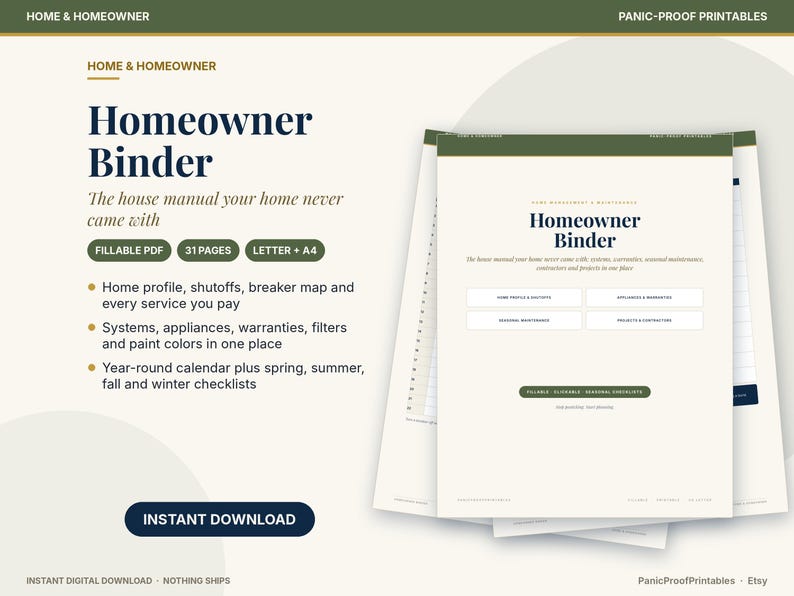
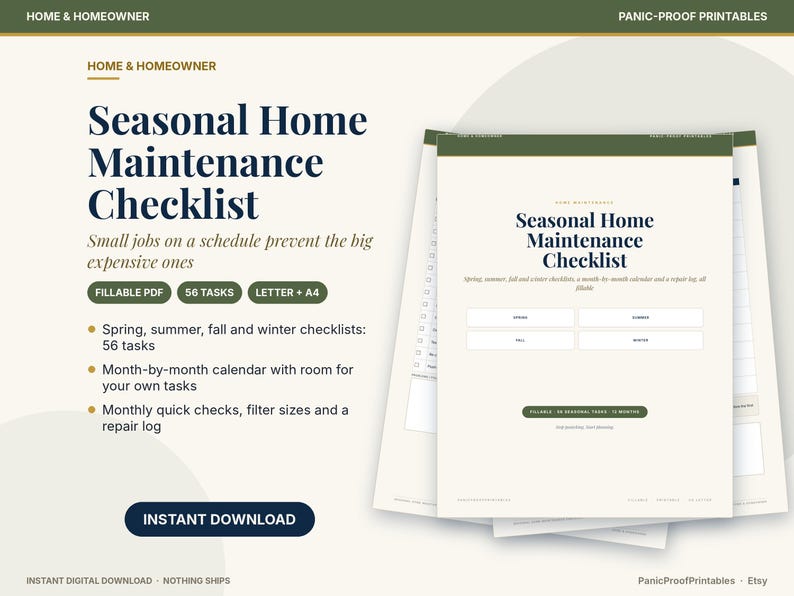
Our free one-page When Did I Last? sheet is exactly this, for twelve recurring household tasks with their sourced intervals, filter included. If you want the filter tracked alongside the rest of the house, the fillable Homeowner Binder has a filters, bulbs and batteries page next to the appliance register, so the filter size and the date live on the same sheet as the model number of the unit that uses it. The smaller Seasonal Home Maintenance Checklist has the same filters page plus monthly quick checks across all twelve months. Both are part of our Home and Homeowner collection.
What to write down
- The nominal size printed on the filter frame, including the thickness (for example 16 x 25 x 1).
- The MERV or MPR rating, so the replacement matches what the system was designed to pull air through.
- The date installed, written on the tracker and in marker on the filter's cardboard edge.
- The interval you are using: 90 days for a 1-inch filter unless monthly checks say otherwise.
- The next due date, which is the only number you need to look at afterward.
Where to put the cue
- Tape the tracker to the furnace or air handler cabinet. The cue should be where the task happens.
- Keep two spare filters next to the unit. The most common reason a due filter stays in is that the new one is still at the store.
- Pair the monthly glance with something that already happens monthly, such as the day the electric bill arrives.
- If you keep a digital version, put the due date, not a repeating reminder, in your calendar. A reminder on the first of every month gets dismissed; a specific due date gets done.
A simple routine for a 1-inch filter
- Turn the system off at the thermostat before pulling the filter.
- Note the airflow arrow on the frame and install the new filter pointing the same way, toward the blower.
- Write today's date on the new filter's edge and on the tracker.
- Add 90 days and write the due date. If the old filter came out dark gray well before 90 days, shorten the interval to 60.
- Once a month, glance at the tracker and at the filter face. Gray means change it now, whatever the date says.
If your system uses a 4-inch or 5-inch media cabinet, the same routine applies with a six-month check and a twelve-month ceiling. And if a filter is loading up far faster than any of the intervals above, that is worth mentioning to an HVAC contractor at the yearly tune-up, because it can point to a duct or return problem rather than a filter problem.
Frequently asked questions
- How often should a 1-inch HVAC filter be changed?
- Check it monthly and replace it at least every three months, or sooner if it looks gray. That is the ENERGY STAR guidance, and 3M Filtrete gives the same 90-day ceiling for 1-inch filters.
- How often should a 4-inch or 5-inch filter be changed?
- Manufacturers say every 6 to 12 months depending on use. Honeywell Home quotes 6 to 12 months for its 4-inch F100 filter; 3M Filtrete says at least every 12 months for 4-inch and 5-inch filters.
- Does a dirty filter actually cost money?
- ENERGY STAR's maintenance checklist stops short of a number: a dirty filter "can increase energy costs and damage your equipment, leading to early failure." No agency publishes a percentage for what one clogged filter costs, so the honest framing is mechanical: a starved blower runs longer and harder to move the same air.
- What is the easiest way to remember to change it?
- Write the install date on the filter edge and on a tracker taped to the unit, add the interval, and glance at the due date once a month. Keep two spares next to the furnace so the change can happen the day it is due.
Sources
- ENERGY STAR, Spring Savings (filter check and replacement)
- ENERGY STAR, Heating and Cooling Maintenance Checklist
- U.S. Department of Energy, Energy Saver Guide (PDF)
- 3M Filtrete, filter replacement guidance
- Honeywell Home, F100 Whole-House Media Air Cleaner
- AprilAire, FAQs: Air Purifiers and Air Filters
This article is organizing guidance, not legal, medical, tax or financial advice. For advice about your situation, talk to a licensed professional.