A seasonal home maintenance checklist is a short list of tasks grouped by spring, summer, fall and winter, with each interval taken from a source that has a reason to know. Below are the tasks we could verify, the source behind each one, a table that lays them out by season, and the four tasks whose consequences are measured in fires and poisonings rather than repair bills.
Why a seasonal home maintenance checklist beats one long list
Most maintenance intervals are not arbitrary. Cooling equipment should be checked before summer and heating equipment before winter because that is when the equipment will be asked to work, and because, as ENERGY STAR puts it, "contractors get busy once summer and winter come" (ENERGY STAR). Gutters matter most before the wet seasons. Hoses need draining before the first freeze. A list organized by season puts each task next to the weather that makes it urgent.
The University of Georgia Extension publishes a home maintenance checklist built around exactly this idea, "regular spring and fall home maintenance evaluations," with a note that frequencies may vary with local climate and manufacturer recommendations (University of Georgia Extension). We lean on it below for the exterior, plumbing and electrical items, and on NFPA, the U.S. Fire Administration, ENERGY STAR and the Department of Energy for the safety and mechanical ones.
Spring
- Cooling system check-up. ENERGY STAR recommends an annual pre-season check-up, with cooling checked in the spring (ENERGY STAR).
- Gutters and downspouts. Clean them and make sure they discharge water 2 to 3 feet away from the house; the Extension checklist notes this may need to be done more often (University of Georgia Extension).
- Roof, flashing and attic. Check flashing around the chimney, vents and skylights, inspect shingles and soffits, and look for leaks and pests in the attic (University of Georgia Extension).
- Exterior and foundation. Inspect siding and trim for loose or peeling pieces and the foundation and masonry for cracks (University of Georgia Extension).
- Electrical. Trip the circuit breakers and test ground fault interrupters, and check cords and outlets (University of Georgia Extension).
- Dryer duct. Vacuum lint from the ducts and the area around the dryer, in addition to cleaning the filter after each use (University of Georgia Extension).
- Water heater. Inspect for leaks and corrosion and test the temperature and pressure relief valve (University of Georgia Extension).
Summer
- Air conditioner filter. The Department of Energy's Energy Saver Guide states: "Clean or replace filters on air conditioners once a month or as recommended" (U.S. Department of Energy). ENERGY STAR's maintenance checklist goes further on cost: a dirty filter "can increase energy costs and damage your equipment, leading to early failure" (ENERGY STAR).
- Water heater sediment. The Department of Energy's home energy guide says to "drain a quart of water from your water tank every 3 months" to remove sediment, so this one recurs in every season (U.S. Department of Energy).
- Deck, fence and hoses. Inspect for wood rot and reseal as needed; check garden hoses for leaks (University of Georgia Extension).
- Monthly safety tests. Test every smoke alarm and CO alarm at least once a month, all year (NFPA, smoke alarms; NFPA, carbon monoxide), and check that the fire extinguisher is fully charged (University of Georgia Extension).
Fall
- Heating system check-up. ENERGY STAR's pre-season check-up for heating belongs in the fall (ENERGY STAR). NFPA is more specific about fuel-burning equipment: "chimneys and heating systems should be inspected and cleaned each year before they are fired up for the season" (NFPA, heating).
- Furnace filter. The monthly inspection continues; ENERGY STAR says to change the filter at least every three months or whenever it looks dirty (ENERGY STAR).
- Outdoor water. Drain outdoor faucets and hoses and store the hoses for winter (University of Georgia Extension).
- Gutters, again. The Extension checklist lists gutter cleaning for both spring and fall evaluations (University of Georgia Extension).
- Windows and doors. Check weather-stripping and caulking, and repair or replace cracked glass (University of Georgia Extension).
- Alarm batteries. Change the batteries in smoke and carbon monoxide alarms (University of Georgia Extension). NFPA notes that a unit with a non-replaceable 10-year battery is swapped out whole at the end of its life instead (NFPA, smoke alarms).
Winter
- Vents clear of snow. During and after a snowstorm, make sure the vents for the dryer, furnace, stove and fireplace are clear of snow build-up (NFPA, carbon monoxide).
- Generators outdoors only. If a storm takes the power out, a generator belongs in a well-ventilated location outdoors, away from windows, doors and vent openings (NFPA, carbon monoxide).
- Basement and crawl space. Check for moisture, mold and leaks, and confirm the sump pump and floor drain work (University of Georgia Extension).
- Monthly tests continue. Nearly half of home heating fires (46 percent) occur from December through February (NFPA, heating), which makes the winter alarm tests the ones not to skip.
The checklist by season
| Season | Tasks | Interval | Source |
|---|---|---|---|
| Spring | Cooling check-up; gutters; roof and flashing; exterior and foundation; GFCI test; dryer duct; water heater valve | Yearly, or each spring and fall | ENERGY STAR; UGA Extension |
| Summer | AC filter; deck and fence; hoses | Filter once a month in cooling season, or as recommended | U.S. DOE; UGA Extension |
| Fall | Heating check-up; chimney inspection and cleaning; drain outdoor faucets; gutters; weather-stripping; alarm batteries | Yearly, before the heating season | ENERGY STAR; NFPA; UGA Extension |
| Winter | Keep vents clear of snow; basement moisture; sump pump | After each snowfall; seasonal | NFPA; UGA Extension |
| Every season | Drain a quart from the water heater; check furnace filter | Every 3 months; monthly check | U.S. DOE; ENERGY STAR |
| Every month | Test smoke alarms and CO alarms; check fire extinguisher | Monthly | NFPA; UGA Extension |
| Multi-year | Replace smoke alarms; pump septic tank; test for radon | 10 years; every 3 to 7 years; every 2 years | NFPA; UGA Extension |
The four tasks with safety consequences
Most of the list above protects money. Four items protect people, and each has a number behind it.
1. Test smoke alarms monthly and replace them at 10 years
NFPA says to test every smoke alarm at least once a month using the test button, and that "all smoke alarms must be replaced 10 years after its manufacturing date." Roughly three out of five home fire deaths happen in homes with no smoke alarms or no working ones, and the risk of dying in a home fire is cut by 60 percent when working alarms are present (NFPA, smoke alarms). The manufacture date is printed on the back of the unit; it belongs on your checklist.
2. Test CO alarms monthly and keep fuel vents clear
Carbon monoxide alarms should be tested at least once a month and replaced according to the manufacturer's instructions, with alarms outside each sleeping area and on every level. NFPA cites a 2023 CDC study finding unintentional, non-fire CO poisoning responsible for roughly 101,847 emergency department visits and at least 430 deaths a year over 2005 to 2018 (NFPA, carbon monoxide).
3. Clean the dryer lint filter every load and the duct every season
The U.S. Fire Administration estimates 2,900 clothes dryer fires in residential buildings reported each year over 2008 to 2010, and names "failure to clean" as the leading contributing factor at 34 percent (U.S. Fire Administration, dryer fire report). Its guidance: clean the lint filter before and after each cycle, clean behind the dryer where lint builds up, and check that the venting is not crushed or restricted and the outdoor flap opens when the dryer runs (U.S. Fire Administration).
4. Have heating equipment and chimneys inspected before each heating season
Fire departments responded to an estimated 37,365 heating equipment fires a year from 2020 to 2024, with space heaters and heating stoves responsible for over seven in ten of the deaths (NFPA, heating). The annual inspection and cleaning is the task on this list most worth paying a professional for. Gas, electrical and roof work generally belong with licensed trades; a checklist tells you when to call, not how to do the job.
Odd intervals that need a written date
A few items do not fit a seasonal rhythm, which is exactly why they get missed. The Extension checklist puts septic pumping at every 3 to 7 years, radon testing every 2 years, and private well testing on a regular schedule (University of Georgia Extension). Smoke alarm replacement runs on a 10-year clock (NFPA, smoke alarms). None of these can be remembered; they have to be written down with a last-done date and a next-due date.
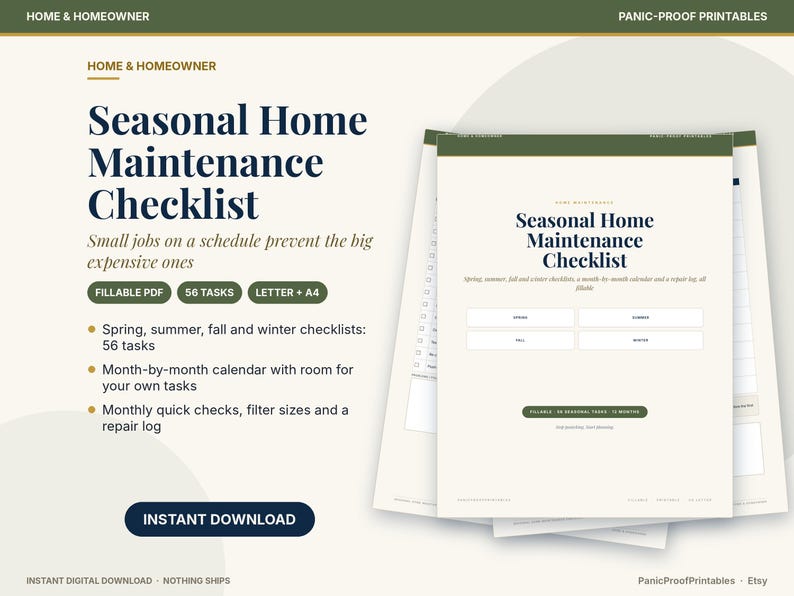
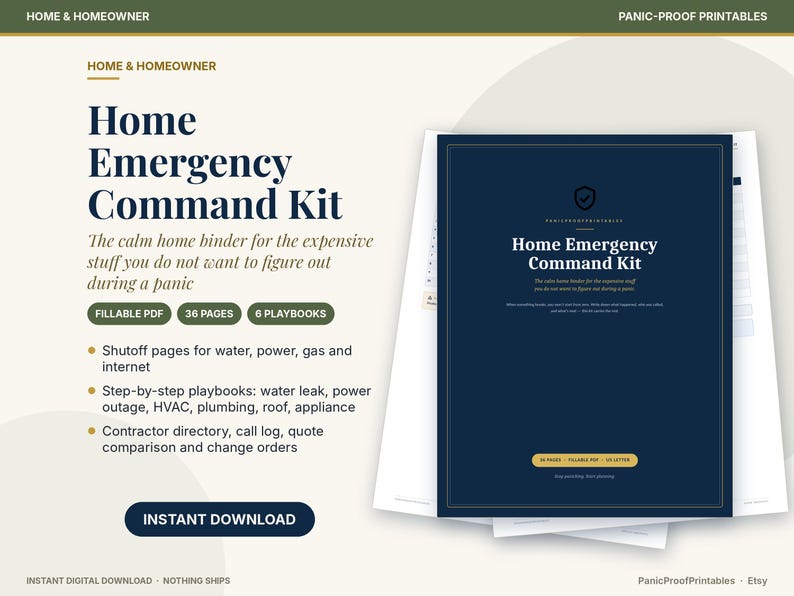
That is the reason our free When Did I Last? one-page sheet exists: twelve recurring tasks, each with its sourced interval and a box for the date. The Seasonal Home Maintenance Checklist expands that into 56 tasks across the four seasons with a month-by-month calendar, monthly quick checks and a repair log, all fillable. If you want the maintenance calendar living next to your shutoff locations, breaker map and warranties, the Homeowner Binder holds all of it in one PDF, and the Home Emergency Command Kit adds the playbooks for the night something fails anyway. All three are in the Home and Homeowner collection.
Frequently asked questions
- How often should gutters be cleaned?
- The University of Georgia Extension checklist lists gutter and downspout cleaning for both the spring and fall evaluations, with a note that it may need doing more often. Make sure downspouts discharge 2 to 3 feet from the house.
- How often should smoke alarms be tested and replaced?
- NFPA says test them at least once a month and replace every unit 10 years after its manufacture date, which is printed on the back of the alarm.
- How often does a water heater need to be flushed?
- The Department of Energy's home energy guide says to drain a quart of water from the tank every 3 months to remove sediment. Check the manufacturer's manual for your model, and test the relief valve each spring and fall.
- When should HVAC service be scheduled?
- ENERGY STAR recommends annual pre-season check-ups: cooling in spring and heating in fall, before contractors get busy. NFPA adds that chimneys and heating systems should be inspected and cleaned each year before the heating season.
Sources
- NFPA, Smoke Alarm Information
- NFPA, Carbon Monoxide Safety
- NFPA, Home Heating Safety
- ENERGY STAR, Heating and Cooling Maintenance Checklist
- ENERGY STAR, Spring Savings (filter guidance)
- U.S. Department of Energy, Energy Saver Guide (PDF)
- U.S. Department of Energy, Energy Savers: Tips on Saving Money and Energy at Home (PDF)
- U.S. Fire Administration, Clothes Dryer Fire Safety flyer (PDF)
- U.S. Fire Administration, Clothes Dryer Fires in Residential Buildings 2008-2010 (PDF)
- University of Georgia Extension, Home Maintenance Checklist (Circular 1082)
This article is organizing guidance, not legal, medical, tax or financial advice. For advice about your situation, talk to a licensed professional.